
English| EUR
Suggested for you
More currencies
Choose a language
Abisko's position relative to the Arctic Circle determines more than geography—it shapes the aurora season, daylight hours, and the reliability of Northern Lights sightings. Understanding the village's latitude clarifies why it holds one of the planet's most consistent aurora records.
Quick answer
Yes, Abisko is in the Arctic Circle. The village sits at 68°21′N latitude, approximately 195 kilometers north of the Arctic Circle line at 66°33′N. This northern position places Abisko firmly within the auroral oval's prime viewing zone, where geomagnetic activity converges with minimal light pollution and the region's unique meteorological conditions create consistently clear skies during the aurora season from September through March.
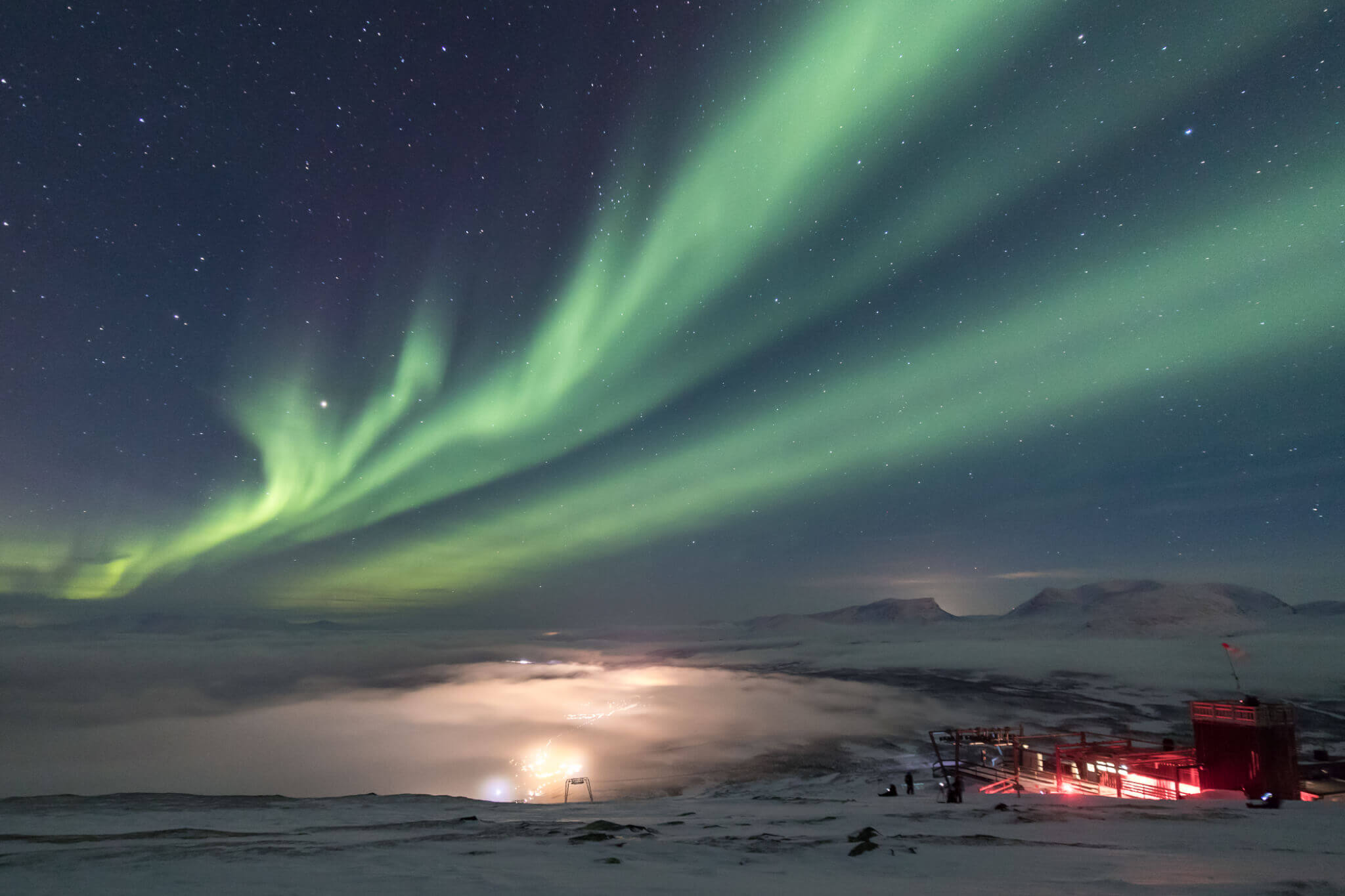
Abisko occupies a narrow wedge of Swedish Lapland where the Abisko River valley cuts eastward through the Scandinavian mountain range, channeling dry continental air from the interior and creating a microclimate that defies the region's otherwise persistent cloud cover. The village sits at 68°21′N, placing it 195 kilometers beyond the Arctic Circle's southern boundary at 66°33′N—a distance that translates to nearly three degrees of latitude and a marked difference in solar exposure. During winter solstice, Abisko experiences polar night, with the sun remaining below the horizon for weeks; during summer solstice, the midnight sun circles the sky without setting. This axial tilt defines the rhythm of life and travel above the Arctic threshold. The question of whether Abisko lies within the Arctic Circle matters most for aurora tourism. The auroral oval—a ring-shaped zone where charged solar particles collide with Earth's magnetosphere—centers on the magnetic poles and extends roughly between 65° and 72° latitude during moderate geomagnetic activity. Abisko's position near the center of this band ensures that even minor solar storms produce visible displays, while stronger events generate curtains of green, violet, and red light that fill the entire dome of the sky. The village's location within Abisko National Park, established in 1909, further shields it from anthropogenic light sources, preserving the darkness required for aurora observation. The Abisko Sky Station, perched 900 meters above sea level on Mount Nuolja, exploits both the latitude and the valley's meteorological advantage. The station's elevation lifts observers above lingering inversion layers, and the eastward orientation of the valley allows polar high-pressure systems to suppress cloud formation—a phenomenon so reliable that the area is marketed as having a "blue hole" of clear skies. Records from the Swedish Meteorological and Hydrological Institute confirm that Abisko experiences fewer overcast nights during the aurora season than comparable sites in Norway, Finland, or Iceland, despite sharing the same latitude band. The combination of being well inside the Arctic Circle and benefiting from anomalous weather patterns makes the answer to whether Abisko qualifies as an Arctic aurora site unambiguous. Visitors planning Northern Lights observation should note that latitude alone does not guarantee visibility—timing, solar activity, and local weather still govern each night's outcome. But Abisko's Arctic Circle position ensures that when conditions align, the auroral oval sits directly overhead rather than low on the northern horizon, producing displays with greater intensity, duration, and color variation than sites closer to the Circle's southern edge.
“Abisko sits 195 kilometers north of the Arctic Circle, placing it near the center of the auroral oval where even moderate solar storms produce visible displays.”
Abisko is situated approximately 195 kilometers north of the Arctic Circle, placing it firmly within the sub-arctic region. This latitude creates specific atmospheric conditions that contribute to the frequency of the Northern Lights.
Abisko is located at 68.35° N, well above the Arctic Circle boundary of 66.5° N. This position places the village within the auroral zone, where geomagnetic activity frequently occurs.
The presence of the large Torneträsk lake creates a microclimate known as the Blue Hole of Abisko. This phenomenon often results in clear skies even when surrounding mountain regions experience cloud cover.
The village lies directly under the auroral oval, a ring-shaped zone around the geomagnetic pole where aurora displays are most intense. This location allows for observation of the phenomenon during periods of moderate solar activity.
Abisko is located roughly 195 kilometers north of the Arctic Circle line. Being deep within the northern latitudes ensures extended periods of darkness during the winter months.
While geographic latitude is 68.35° N, the geomagnetic latitude is approximately 65° N. This specific alignment is optimal for the visibility of the aurora borealis.
The surrounding Scandinavian Mountains create a rain shadow effect that limits precipitation. This topographical configuration results in a higher number of cloud-free nights compared to other locations at similar latitudes.
The period from late September to late March offers the darkness necessary for Northern Lights visibility in Abisko. During these months, the Arctic night provides the requisite conditions for aurora observation.
Temperatures 0°C to -10°C; variable conditions. Early season offers darkness without extreme sub-zero cold.
Temperatures -10°C to -25°C; frequent cloud cover. The polar night provides constant darkness for potential sightings.
Temperatures -5°C to -20°C; historically clearer skies. Lengthening nights often align with optimal auroral activity.
Verdict: The best window for Northern Lights visibility is February to March, when the combination of darkness and historically clear skies creates favorable conditions.
Abisko is located in Swedish Lapland, approximately 200 kilometers north of the Arctic Circle. The most direct approach for visitors is via train or road to the Abisko National Park area.
Vy Night Train or SJ InterCity to Abisko Turiststation
Länstrafiken Norrbotten Line 91 to Abisko Turiststation
E10 highway via Kiruna
Alighting at the Abisko Turiststation stop provides the most convenient access to the park's main trails and facilities. Ensure you check local transport schedules in advance, as services are adapted for regional travel.
Abisko National Park is accessible at all hours, allowing visitors to explore the Arctic Circle landscape throughout the day and night.
Extreme cold and remote location require gear and preparation beyond typical travel.
Everything you need to know about is abisko in the arctic circle
Yes, Abisko is in the Arctic Circle, located approximately 200 kilometers north of this line in Swedish Lapland. Being situated well within this latitude makes it one of the most reliable places globally to witness the aurora borealis. Visitors often ask is abisko in the arctic circle to confirm its prime position for high-latitude sky watching. Because of its unique location, the area experiences the phenomenon of the polar night during winter months. Many travelers searching is abisko in the arctic circle are looking for the best conditions for winter excursions. The scientific research station in the village contributes to a documented "blue hole" effect, where surrounding mountains help keep the sky clear despite regional weather patterns. This geographical benefit is why many choose an Abisko aurora tour for their travel plans. You should plan your visit during the dark winter months between September and April to maximize your chances of seeing the lights. Consistent dark, clear skies are essential, and the area remains accessible during the 00:00–23:59 window. It is important to remember that is abisko in the arctic circle means preparing for significant temperature drops and limited daylight. Entry to Abisko National Park is 0 SEK, as there is free entry to the national park. While fees apply for specific services or facilities like guided snowmobile tours, the park itself remains open to the public at all times. The park is well-connected by rail and road, making it accessible from major Swedish transport hubs. Visitors often travel to the village by train, which stops conveniently near the park entrance, or by bus from Kiruna. Always check local transit schedules when planning your journey to this remote northern landmark. Yes, families often visit the area to experience the wilderness and winter activities. While a snowmobile tour may have age restrictions for safety, the park itself offers trails suitable for various activity levels. Planning ahead ensures that all members of your group can safely enjoy the snowy landscape. Dressing in layers is crucial, as is abisko in the arctic circle implies harsh arctic conditions even on sunny days. You will need high-quality thermal gear, waterproof boots, and specialized equipment if you plan to participate in a snowmobile excursion. Always prioritize warmth and comfort to make the most of your time in the wilderness.